
The best hog feeder is sized by herd, not by brand: a 2.2-bushel single-door feeder like the VEVOR holds enough for 5 pigs, while a 3.7-bushel two-door unit feeds about 8. A bushel of shelled corn weighs 56 pounds, so capacity in bushels tells you refill frequency directly.
That is the whole decision, and it is arithmetic rather than opinion. Work out how many animals you are feeding, how often you are willing to walk out with a sack, and the capacity follows. Everything else — galvanising, door design, rolled edges — is about how much feed ends up on the ground instead of in a pig.
Capacity, in Numbers
| Feeder | Capacity | Doors | Rated for |
| VEVOR 2.2 Bushel | 2.2 bu (≈123 lb corn) | 1 | Up to 5 hogs |
| Brower 11H | 1.5 bu / 50 lb | 1 | Piglets to adult sows |
| Two-Door 3.7 Bushel | 3.7 bu (≈207 lb corn) | 2 | Up to 8 pigs |
| Little Giant HGFS | 50 lb | 1 | Small groups, supplemental |
The bushel-to-pounds figures above assume shelled corn at the standard 56 pounds per bushel. Pelleted feed and ground rations run lighter per bushel, so treat those weights as an upper bound.
VEVOR 2.2 Bushel Single Door — Best Value
Galvanized steel, 2.2 bushels, one door, rated by the maker for up to 5 hogs. It is the cheapest feeder here by a wide margin and it holds more than two of the more expensive ones.
The detail worth naming is the rolled edge around the trough opening. A raw cut edge on galvanized sheet is sharp, and pigs push into a feeder hard enough to cut themselves on one — rolled edges are a safety feature, not a finish.
Galvanising is the other thing to check on any feeder that lives outdoors. Painted steel in a pig pen rusts from the inside out where feed stays damp against it.
CHECK LATEST PRICE ON AMAZON.COM
Two-Door 3.7 Bushel — Best for a Larger Group
Galvanized steel, gravity-fed, 3.7 bushels, two feed ports, a weatherproof lid and a feed-level viewing window. Rated for up to 8 pigs.
Two doors is not simply twice the throughput. Pigs establish a hierarchy at the feeder and a single door lets a dominant animal hold the whole trough, so the smallest in the group grows slowest. Two ports reduce that, and if you are feeding a mixed-size group it is the most useful upgrade on this page.
The viewing window sounds like a small thing and is not. Checking a level through a window takes a glance from the fence; checking it by lifting a lid means walking into the pen.
CHECK LATEST PRICE ON AMAZON.COM
Brower 11H Single Door — Best for Mixed Ages
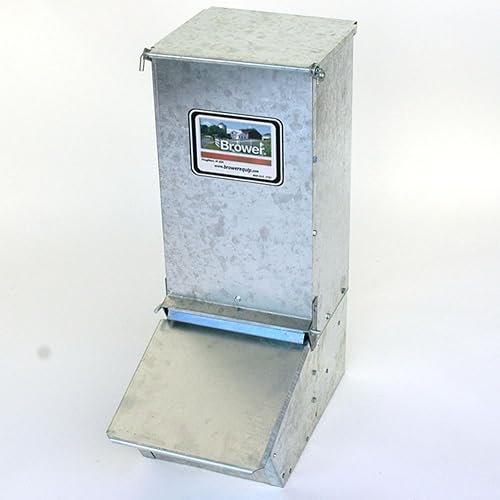
A 1.5-bushel, 50-pound supplemental feeder that Brower rates from four-week-old piglets right through to adult sows. That span is the reason to buy it: a feeder that works for weaners usually has a trough too shallow for grown animals, and one built for sows is unreachable for piglets.
It is a supplemental feeder, not a main ration feeder for a full-grown group. Used as the only feed source for adult hogs you will be refilling it daily.
CHECK LATEST PRICE ON AMAZON.COM
Little Giant HGFS Single Door
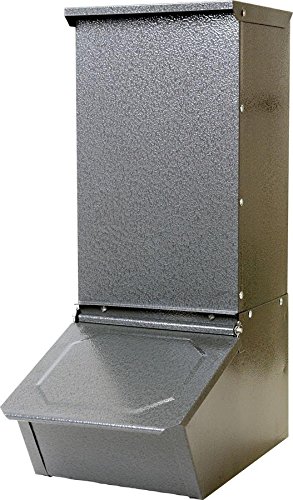
Fifty pounds, single door, from Miller Manufacturing’s Little Giant line — the brand most farm stores stock, which matters when you need a part rather than a whole feeder.
It is the most expensive 50-pound feeder here and the argument for it is availability of support rather than capacity. If you already run Little Giant waterers and troughs, matching the feeder is reasonable. If you do not, the VEVOR holds more for less.
CHECK LATEST PRICE ON AMAZON.COM
Feed Waste Is the Real Cost
A feeder costs what it costs once. Wasted feed costs every week, and over a year it dwarfs the price difference between anything on this page.
Three things drive it. Door or gate adjustment — most gravity feeders let you set how far feed drops into the trough, and set too generously the pigs root it onto the ground. Start restrictive and open it until the trough stays shallowly covered. Trough lip height — a shallow lip lets feed get pushed out; too deep and young animals cannot reach. Weather — feed that gets wet cakes, moulds and stops flowing, which is what the weatherproof lid on the two-door unit above is for.
A useful habit: watch the feeder for five minutes after a fill. If feed is on the ground inside those five minutes, the gate is open too far.
Feeder Spaces, and Where to Put It
One number does most of the work in feeder sizing and it is not capacity. The common husbandry rule of thumb is roughly one feeder space per 4 to 5 growing pigs. A single-door feeder is one space; the two-door unit above is two. So the 2.2-bushel single door is sized about right for the 5 hogs its maker quotes, and the 3.7-bushel two-door for 8 to 10 — the capacity and the space count happen to agree, which is not always true of cheaper feeders that advertise a big hopper behind one narrow door.
If you see pigs queueing, or one animal standing over the trough while others wait, you are short of spaces regardless of how much feed the hopper holds.
Placement, in order of how much trouble it saves:
Well-drained ground. A feeder in a wet spot becomes a wallow, and feed that falls into mud is gone. Gravel or a concrete pad under the feeder pays for itself.
Away from the waterer. Pigs carry water back to feed and cake it. A few yards of separation keeps the hopper flowing.
Anchored. An unsecured feeder gets rooted over, which empties the hopper in one go. Stake it, bolt it to a post, or weight the base.
Under cover if you can manage it. A weatherproof lid handles rain falling straight down; it does not handle driving rain or a snow load. Even a sheet of tin over the top changes how often you are breaking up caked feed.
Gravity-Fed or Trough
A gravity feeder holds a hopper of feed above a trough and lets it fall as the animals eat, so it refills itself and you fill the hopper. That is what every unit on this page is, and it is the right choice for free-choice feeding.
A plain trough holds one meal and nothing more. It gives you exact control over ration size, which matters if you are restricting intake — for gestating sows, for instance — and it is far cheaper. If you are measuring feed rather than letting animals eat freely, a trough is the correct tool and a hopper works against you.
If You Landed Here Looking to Hunt Wild Hogs
Different job entirely, and worth saying plainly because the two get conflated. The feeders above are livestock equipment for raising pigs. Baiting wild hogs needs a timed or gravity game feeder, and local rules on baiting vary considerably by state — check your own regulations first.
The one piece of overlap worth owning is a feeder light.
Vizzlema Green Solar Feeder Light
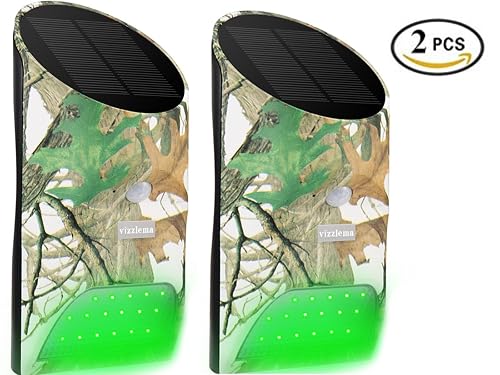
A motion-activated green LED that mounts over a feeder and runs on solar, sold in pairs. Green rather than white because hogs are far less sensitive at the red and green end of the spectrum than they are to a white beam, so it lights the bait without emptying the area.
Solar matters here more than it would elsewhere: a feeder site is somewhere you visit rarely, and a light that needs batteries changed is a light you will find dead. For the handheld and rifle-mounted side of night hunting, see our guide to hog hunting lights.
CHECK LATEST PRICE ON AMAZON.COM
Our Pick
For most small holdings the VEVOR 2.2-bushel is the sensible buy: it holds more than the two 50-pound feeders and costs less than either. Step up to the two-door 3.7-bushel if you are feeding a mixed-size group, because the second port is what stops the biggest pig owning the trough. The Brower 11H earns its place on the piglet-to-sow range, and the Little Giant on parts availability. Whichever you choose, spend the first week adjusting the gate rather than admiring the steel — that is where the money actually goes.